.png)
.png)
.png)
.png)
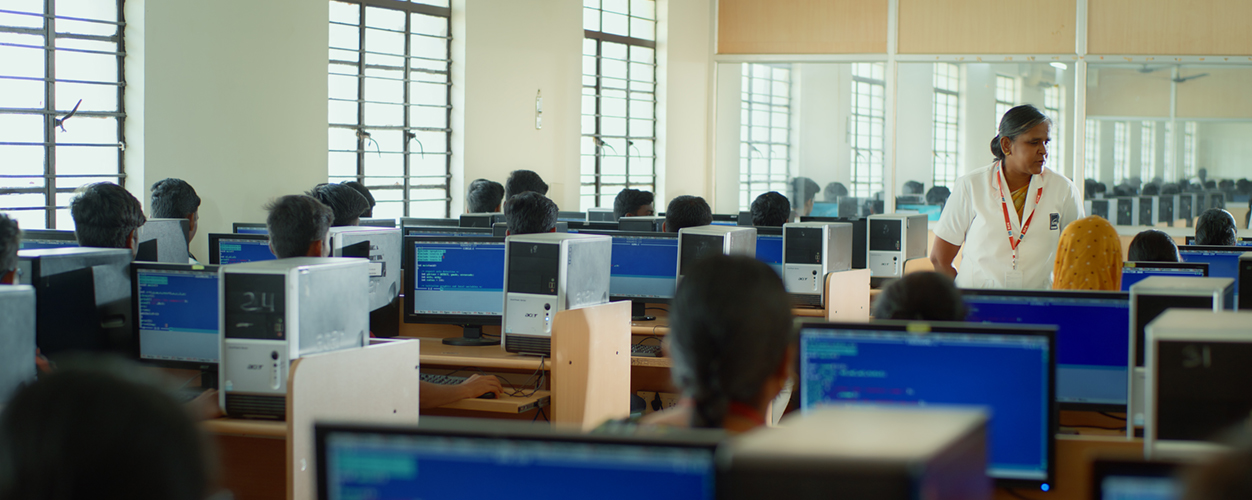
Information Technology (IT) offers a promising career to students. It experiences phenomenal growth every year. IT deals with the effective use of computer software systems. When computer and communication technologies are combined, the result is information technology or “InfoTech”. Hence, it is imperative to learn the prospects of B.Tech. Information Technology. The Department offers an excellent atmosphere for students to learn and acquire the necessary skills demanded by the industry. The department provides the best infrastructure and educational resources for students which help them to stimulate self-learning and best practice. IT Professionals will find their jobs in various key areas like Networking, Full Stack Web Development, Mobile Application Development, Cloud Computing, Data Science, and Cyber Security.
To cultivate a generation of globally competitive IT professionals who are equipped with the knowledge, skills, and adaptability to flourish amidst technological advancements.
B.Tech in Information Technology (IT) offers a wide and dynamic career scope, especially in today’s digital-first world. The programme enables students to build strong foundations in computing, software development, data technologies, cybersecurity, and emerging digital innovations.
Information Technology plays a crucial role in transforming industries through software solutions, intelligent systems, cloud infrastructure, and data-driven decision-making. The programme prepares students with technical expertise, problem-solving abilities, and professional skills required to succeed in the global technology ecosystem.
IT graduates are equipped to contribute across diverse sectors including software development, artificial intelligence, finance, healthcare, education, cybersecurity, automation, and digital services.
The Information Technology department plays a crucial role in fast-growing technological domains.
Top global technology companies driving innovation include Google, Microsoft, Amazon, and IBM.
Although Information Technology is software-focused, it also connects with hardware, networking, and infrastructure domains.
IT professionals often work with enterprise hardware systems supplied by companies like Cisco Systems and Intel.
GATE qualification increases opportunities in higher studies and public sector jobs.
The private sector offers extensive opportunities for IT graduates across multiple technology-driven industries.
Major recruiters include Tata Consultancy Services, Infosys, Wipro, Accenture, and Capgemini.
IT graduates can work in government departments and Public Sector Undertakings (PSUs).
Government jobs provide job security, structured promotions, and stable income.
IT departments encourage research, innovation, and industry collaboration through advanced projects, practical exposure, and technology-driven solutions.
Collaboration often happens with companies like IBM and Oracle Corporation for advanced solutions.
The IT field has significant societal and global influence. Beyond technical skills, IT professionals are expected to follow ethical computing practices and contribute responsibly to digital transformation.
IT professionals contribute to sustainable development, digital transformation, and inclusive growth worldwide.
Apply knowledge of mathematics, natural science, computing, engineering fundamentals and an engineering specialization to develop to the solution of complex engineering problems.
Identify, formulate, review research literature and analyze complex engineering problems reaching substantiated conclusions with consideration for sustainable development.
Design creative solutions for complex engineering problems and design/develop systems/components/processes to meet identified needs with consideration for the public health and safety, whole-life cost, net zero carbon, culture, society and environment as required.
Conduct investigations of complex engineering problems using research-based knowledge including design of experiments, modelling, analysis & interpretation of data to provide valid conclusions.
Create, select and apply appropriate techniques, resources and modern engineering & IT tools, including prediction and modelling recognizing their limitations to solve complex engineering problems.
Analyze and evaluate societal and environmental aspects while solving complex engineering problems for its impact on sustainability with reference to economy, health, safety, legal framework, culture and environment.
Apply ethical principles and commit to professional ethics, human values, diversity and inclusion; adhere to national & international laws.
Function effectively as an individual, and as a member or leader in diverse/multi-disciplinary teams.
Communicate effectively and inclusively within the engineering community and society at large, such as being able to comprehend and write effective reports and design documentation, make effective presentations considering cultural, language, and learning differences.
Apply knowledge and understanding of engineering management principles and economic decision-making and apply these to one’s own work, as a member and leader in a team, and to manage projects and in multidisciplinary environments.
Recognize the need for, and have the preparation and ability for i) independent and life-long learning ii) adaptability to new and emerging technologies and iii) critical thinking in the broadest context of technological change.
Graduates will be able to
To ensure graduates,
Have proficiency in programming skills to design, develop and apply appropriate techniques, to solve complex engineering problems.
Have the knowledge to build, automate and manage business solutions using cutting-edge technologies.
Have excitement about research in applied computer technologies.
| S.No. | Batch | Course Outcomes |
|---|---|---|
| 1 | IT - R2023 | View Course Outcome |
| S. No. | Name of the Faculty Members/Student/Parent | Designation & Address |
|---|---|---|
| 1 | Mrs. C. Kalpana |
Head of the Department(i/c), Department of Information Technology, NPR College of Engineering and Technology, Natham, Dindigul |
| 2 | Dr. S. Selvaperumal |
Principal, NPR College of Engineering and Technology, Natham, Dindigul |
| 3 | Mr. A. Barani Dharan |
R & D Engineer - 1, Silicon Labs, Hyderabad. |
| 4 | Mr. Thanga Manikandan Bharathan |
Chief Operating Officer, Hitasoft Technology Solutions Private Limited, Madurai. |
| 5 | Mr. C. Vishnu Balaji |
Final Year IT Student, NPR College of Engineering and Technology, Natham, Dindigul |
| 6 | Mrs. R. Revathi |
MTS, Postal Department Perungudi, Madurai |
| 7 | Mr. G. Senthamarai Kannan |
Head Master, Government High Shool, Thottiyapati, Madurai |
| 8 | Dr. P. Sundaramoorthy |
Assistant Professor, Department of Information Technology, NPR College of Engineering and Technology, Natham, Dindigul. |
| 9 | Ms. S. Arockia Rubi |
Assistant Professor, Department of Information Technology, NPR College of Engineering and Technology, Natham, Dindigul. |
| 10 | Mrs. S. Janet Vidyaa Nancy |
Assistant Professor, Department of Information Technology, NPR College of Engineering and Technology, Natham, Dindigul. |
| 11 | Mrs. A. S. Suriya Pattatharasi |
Assistant Professor, Department of Information Technology, NPR College of Engineering and Technology, Natham, Dindigul. |
The members of the Board of studies are as follows:
| S/N. | Member Category | Name, Designation, and Affiliation |
|---|---|---|
| 1 | Chairman |
Mrs. V. Sujitha Assistant Professor, Department of Computer Science and Engineering, NPR College of College of Engineering and Technology, Dindigul-624401. |
| 2 | University Nominee |
Dr. V. Ramya Associate Professor, Department of Computer Science and Engineering, Government College of Engineering, Bodinayakanur. |
| 3 | Subject Experts from outside the Parent University |
Dr. S. Sreethar Associate Professor, School of Computer Science and Engineering, Vellore Institute of Technology, Vellore-632014. Dr. K. Saravanan Professor, Department of Information Science and Engineering, New Horizon College of Engineering, Bangalore-560103. |
| 4 | Experts from outside the Autonomous College |
Dr. V. Murali Bhaskaran Professor in CSE and Dean Academics, Rajalakshmi Engineering College, Rajalakshmi Nagar, Thandalam, Chennai - 602105. |
| 5 | Expert from Industrial/ Corporate/Allied Sector |
Mr. R. K. Durgesh Senior Associate & Technical Lead, Cognizant Technology Solutions India Pvt. Ltd. ELCOT SEZ, Sholinganallur, Chennai- 600119. |
| 6 | College Alumni |
Mr. K. B. Seshan Senior Developer, Corestack, RMZ One Paramount, Plot:110 1st Floor, Mount Poonamallee Road, Porur, Chennai-600024. Computer Science and Engineering |
| 7 | Faculty Members | Dr. S.M.Vijayarajan |
| 8 | Mr.P.Manivel Pandian | |
| 9 | Mr. M. Arockia Irudayaraja | |
| 10 | Mrs. M.Kalarani | |
| 11 | Mrs. R. Joan Pavithra | |
| 12 | Mrs. J. Bama | |
| 13 | Mrs. A. Arul Princy | |
| 14 | Mr. N. Nagaprakash | |
| 15 | Mrs. P. Prema | |
| 16 | Ms. A. Yuvarani | |
| 17 | Ms. M. Janani | |
| 18 | Mr.A.Janagan | |
| 19 | Mr.A.Suresh | |
| 20 | Mrs.S.Sharmila Jeyarani | |
| 21 | Mrs. P. Kaleeswari | |
| 22 | Mrs. S. Indhumathi | |
| 23 | Mrs. C. Kalpana, HoD(i/c) | |
| 24 | Ms. S. Arockia Rubi, AP | |
| 25 | Mrs. A. S. Surya Pattatharasi, AP | |
| 26 | Mrs. S. Janet Vidyaa Nancy, AP | |
| 27 | Mrs.R.Maheswari | |
| 28 | Ms.T.Shanthi | |
| 29 | Mrs.P.Gobika | |
| 30 | Mrs. J. Prisca Mary | |
| 31 | Mr.A.G.Paranthaman | |
| 32 | Dr. M. Santhosh | |
| 33 | Mrs. D. Priya Dharshini | |
| 34 | Mrs. J. Lilly Roseline Mary | |
| 35 | Mr.S.Sathyaraj | |
| 36 | Mrs.K.Preethi Monika | |
| 37 | Mrs.S.Ummugulthum Natchiar | |
| 38 | Mrs. R. Bhavithra | |
| 39 | Mrs. D. Aiswarya Laxmi | |
| 40 | Mrs. P. Kaleeswari | |
| 41 | Dr.S.Banu Chitra | |
| 42 | Dr.B.N.Bobinath | |
| 43 | Dr.S.Devi | |
| 44 | Dr.M.Sivakami | |
| 45 | Mrs.B.Muralidharan | |
| 46 | Mr.A.Tamil Selvan |
| S.No. | Name of the Staff | Designation | Experience | Details Document |
|---|---|---|---|---|
| 1 | Mrs. C. Kalpana | Head of Department | 10 Years 6 Months | View Details |
| 2 | Ms. S. Arockia Rubi | Assistant Professor | 5 Years 3 Months | View Details |
| 3 | Mrs. S. Janet Vidyaa Nancy | Assistant Professor | 2 Years | View Details |
| 4 | Mrs. P. Gobika | Assistant Professor | 4 Months | View Details |
| S.No | Name | Designation | Date of Joining | Experience |
|---|---|---|---|---|
| 1 | Ms. P. Divya Sri | Lab Assistant | 04/05/2026 | 2 months |
| S.No. | Name of the Society | Name of the Event | Resource Person | Name of the Industry | Academic Year |
|---|---|---|---|---|---|
| 1 | Association for Computing Machinery (ACM) | Inaugural Ceremony of the NPRCET ACM Student Chapter |
Dr.Meenakshi D’Souza President, ACM India Council; Professor & Head, Department of Computer Science and Engineering |
IIIT Bangalore | 2024-2025 |
| 2 | Association for Computing Machinery (ACM) | Peer Learning Session on “Bridging Minds: Sustaining Knowledge Exchange” |
Dr. P. Nagaraj, Associate Professor & Seceretary Madurai ACM Professional Chapter. |
Kalasalingam Academy of Research and Education | 2024-2025 |
| S/N. | Year | Company | Period of MoU | Duration (In Years) |
Objective | Outcome | Status |
|---|---|---|---|---|---|---|---|
| 1 | 2025 | Hebesec Technologies, India & Malysia | 10.10.2025 to 10.10.2028 | 3 years | To collaborate with joint initiatives in cybersecurity training, research, skill development, placements, and industry–academia knowledge exchange. |
|
Active |
| 2 | 2024 | Hitasoft Technology Solutions Private Limited, Madurai | 21.10.2024 to 21.10.2027 | 3 years | To establish collaboration with industry-oriented training, internships, projects, placements, and skill development in emerging IT technologies. |
|
Active |
| 3 | 2024 | Gateway Software Solutions, Coimbatore | 10.09.2024 to 10.09.2027 | 3 years | To provide industry-relevant training, internships, and exposure to current software development practices. |
|
Active |
Fill the form below — our counsellor will get in touch shortly.