.png)
.png)
.png)
.png)
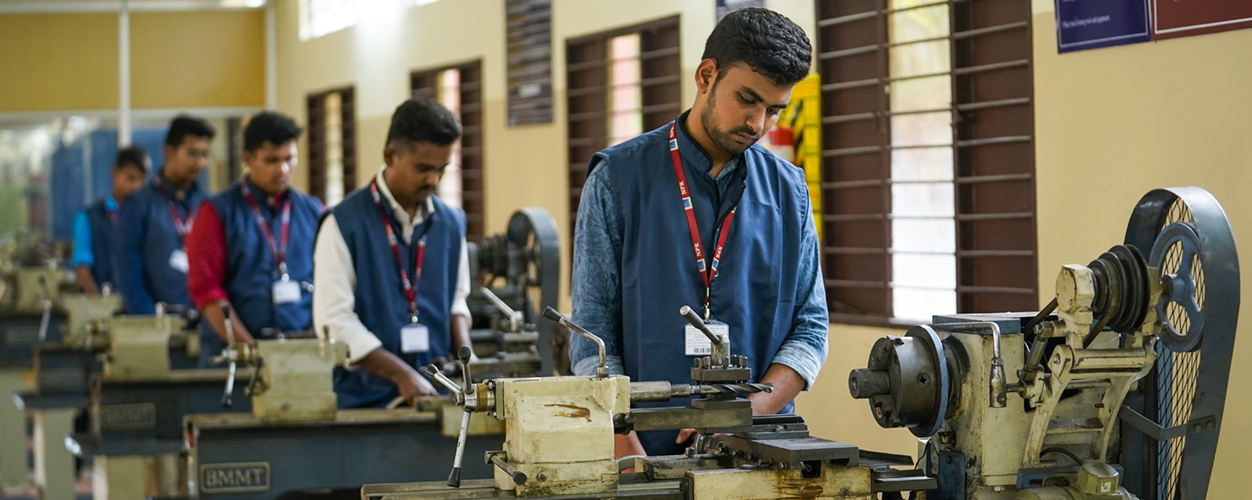
Mechanical Engineering is one of the oldest and broadest branches of engineering, applying principles of engineering physics, engineering mathematics, and materials science to the design, analysis, manufacturing, and maintenance of mechanical systems. The Department of Mechanical Engineering at NPR College of Engineering and Technology was established in 2009 with an annual intake of 60 students. The department is supported by well-qualified and dedicated faculty, modernized laboratories, and a separate departmental library. All laboratory equipment is periodically maintained to ensure efficient and safe operation. The department has secured eight University Ranks in Anna University Examinations and is accredited by the National Board of Accreditation (NBA), reflecting its commitment to quality education and continuous improvement. The department follows an Outcome-Based Education (OBE) teaching–learning methodology to ensure students acquire industry-relevant knowledge, skills, and competencies. To bridge the gap between academia and industry, the department organizes industrial training, internships, and value-added courses. Students are encouraged to participate in co-curricular and extra-curricular activities, including hackathons, symposiums, and project presentations, to enhance innovation and design-thinking skills. The department maintains strong industry linkages, with leading recruiters such as TVS Group, Emerson, India Pistons Limited, NCR Corporation, Aqua Sub Industries, HCL, and Infosys. The department houses eight academic laboratories and an exclusive Centre of Excellence with Advanced Manufacturing Processes and Robotics Laboratories, providing need-based, industry-oriented training in both hardware and software tools. With strong academic foundations, NBA accreditation, OBE-based pedagogy, and robust industry engagement, the Department of Mechanical Engineering at NPR College of Engineering and Technology continues to produce competent and industry-ready mechanical engineers.
To develop qualified mechanical engineers to compete with evolving industrial challenges.
Mechanical Engineering is one of the broadest and most versatile engineering disciplines, driving innovation across industries such as manufacturing, automotive, aerospace, energy, robotics, and automation. At NPR College of Engineering and Technology, our department is committed to delivering a strong foundation in core mechanical principles while integrating modern technological advancements and industry-oriented practices.
We provide a balanced education that combines rigorous theoretical knowledge with hands-on laboratory training, design thinking, and real-world problem-solving. Our future-focused curriculum prepares students to meet evolving industrial demands with technical expertise, creativity, sustainability awareness, and ethical responsibility. Graduates are equipped to become leaders who contribute to industrial growth, technological advancement, and national development.
The scope of Mechanical Engineering spans diverse sectors including manufacturing, thermal systems, energy production, automotive design, mechatronics, robotics, aerospace, and industrial automation. With India’s emphasis on initiatives such as Make in India, Industry 4.0, renewable energy expansion, and advanced manufacturing, the demand for skilled mechanical engineers continues to grow.
Our program develops strong competencies in design, thermal engineering, materials science, production technology, and advanced simulation tools, enabling students to excel in both domestic and global markets.
Students gain exposure to advanced and interdisciplinary domains aligned with global technological trends and national development goals.
Mechanical Engineering graduates are in high demand across multiple industries.
Mechanical Engineering offers extensive opportunities in government services and public sector undertakings through competitive examinations and technical recruitments.
The Mechanical Engineering Department at NPRCET fosters a strong research culture and industry engagement ecosystem. Students are encouraged to participate in funded research projects, technical symposiums, innovation challenges, and patent development.
Advanced laboratories in thermal engineering, fluid mechanics, manufacturing technology, CAD/CAM, and robotics provide hands-on exposure to modern engineering practices.
Through Memorandums of Understanding (MoUs) with leading industries and research institutions, we facilitate internships, industrial visits, live projects, expert lectures, and specialized software training. These collaborations ensure experiential learning and enhance students’ professional readiness for global engineering challenges.
Beyond technical competence, our department emphasizes ethical engineering practices, sustainability, workplace safety, and social responsibility. Mechanical engineers play a critical role in developing energy-efficient systems, reducing environmental impact, improving manufacturing productivity, and advancing transportation technologies.
Our graduates are prepared to design sustainable energy systems, innovate eco-friendly manufacturing processes, contribute to clean mobility solutions, and develop technologies that enhance quality of life.
By combining engineering excellence with ethical values, they become responsible professionals contributing to national progress and global sustainability.
Bachelor of Mechanical Engineering curriculum is designed to impart knowledge, skill and attitude on the graduates to
At the end of the programme, students will be able to:
Apply engineering knowledge using design and analysis tools to solve real-time engineering problems in the areas of structural, thermal, and fluid mechanics.
Acquire knowledge and undertake or execute projects in the areas of modern materials and automobile engineering using contemporary engineering practices.
Apply knowledge of mathematics, natural science, computing, engineering fundamentals and an engineering specialization to develop to the solution of complex engineering problems.
Identify, formulate, review research literature and analyze complex engineering problems reaching substantiated conclusions with consideration for sustainable development.
Design creative solutions for complex engineering problems and design/develop systems/components/processes to meet identified needs with consideration for the public health and safety, whole-life cost, net zero carbon, culture, society and environment as required.
Conduct investigations of complex engineering problems using research-based knowledge including design of experiments, modelling, analysis & interpretation of data to provide valid conclusions.
Create, select and apply appropriate techniques, resources and modern engineering & IT tools, including prediction and modelling recognizing their limitations to solve complex engineering problems.
Analyze and evaluate societal and environmental aspects while solving complex engineering problems for its impact on sustainability with reference to economy, health, safety, legal framework, culture and environment.
Apply ethical principles and commit to professional ethics, human values, diversity and inclusion; adhere to national & international laws.
Function effectively as an individual, and as a member or leader in diverse/multi-disciplinary teams.
Communicate effectively and inclusively within the engineering community and society at large, such as being able to comprehend and write effective reports and design documentation, make effective presentations considering cultural, language, and learning differences.
Apply knowledge and understanding of engineering management principles and economic decision-making and apply these to one’s own work, as a member and leader in a team, and to manage projects and in multidisciplinary environments.
Recognize the need for, and have the preparation and ability for i) independent and life-long learning ii) adaptability to new and emerging technologies and iii) critical thinking in the broadest context of technological change.
| S.No. | Batch | Course Outcomes |
|---|---|---|
| 1 | R21 CO Statement | View Course Outcome |
| 2 | R23 CO Statement | View Course Outcome |
| Sl. No. | Name of the member | Designation / Address | Category |
|---|---|---|---|
| 1 | Dr. S. Selvaperumal | Principal, NPR College of Engineering and Technology. | Program Chairperson |
| 2 | Mr. T. Balasubramani | Assistant Professor, Department of MECH, NPR College of Engineering and Technology, Natham. | HoD |
| 3 | Dr. S. Paulsingarayar | Associate Professor, Department of MECH, NPR College of Engineering and Technology, Natham. | DAC Co-ordinator |
| 4 | Mr. M. Vijayakumar | R&D Caterpillar India Engineering Solutions Pvt.Ltd., Chennai | R&D Member |
| 5 | Mr. S. Senthil Kumar | Technical Head, Assembly session, TAFE, Vadipatti, Madurai. | Industry Expert |
| 6 | Mr. B. B Arun Karthick | Senior Engineer BOSCH Global Software solutions Banglore |
Alumni (2015-2019) |
| 7 | Mr. R. Naveen Raja | Managing Director, Tamizhan Solutions Madurai |
Alumni (2009-2013) |
| 8 | Mr. C. Vijayakumar | Associate Professor, Department of Civil, NPR College of Engineering and Technology, Natham. | Member |
| 9 | Mrs. C. Kannikaparameshwari | Professor, Department of ECE, NPR College of Engineering and Technology, Natham. | Member |
| 10 | Dr. S. M. Vijayarajan | Assistant Professor, Department of CSE, NPR College of Engineering and Technology, Natham. | Member |
The members of the Board of studies are as follows:
| S. No. | Name | Designation, Affiliation | Association |
|---|---|---|---|
| 1 | Mr. T. Balasubramani |
Assistant Professor & Head, Department of Mechanical
Engineering, NPR College of Engineering and Technology, Natham – 624401, Dindigul. |
Chairperson |
| 2 | Dr. K. Linga Durai |
Professor & Dean, Anna University Regional Campus, Madurai. Madurai – 625019, Tamil Nadu. |
University Nominee |
| 3 | Dr. M. Adam Khan |
Professor, Mechanical Engineering, Kalasalingam Academy of Research and Education Krishnankoil – 626126. Virudhunagar District. |
Subject Experts from Outside of the Parent University |
| 4 | Dr. R. Sudhakara Pandian |
Professor, Department of Manufacturing Engineering, School of Mechanical Engineering, VIT University, Vellore Campus, Vellore – 632014., Tamil Nadu |
Subject Experts from Outside of the Parent University |
| 5 | Dr. G. Balakrishnan |
Engineering Manager, Caterpillar India Engineering Solutions Private Limited, Chennai – 600 113. Tamil Nadu. |
Industrial / Corporate Sector / Allied Sector Expert |
| 6 | Mr. B. B. Arun Karthick |
Senior Engineer, BOSCH Global Software Solutions, Bangalore. |
Department Alumni |
| 7 | Dr. PL. K. Palaniapan |
Professor, Department of Mechanical Engineering, Thiagarajar College of Engineering, Madurai – 625 015. |
Subject Experts from Outside the Autonomous College |
| 8 | Dr. T. K. Kannan |
Professor & Dean, Jerusalem College of Engineering, Velachery main road, Narayanapuram, Pallikaranai, Chennai - 600 100, Tamil Nadu |
Subject Experts from Outside the Autonomous College |
| 9 | Dr. K. Nanda Gopal | Professor | Faculty Member |
| 10 | Dr. S. Paulsingarayar | Associate Professor | |
| 11 | Dr. C. Manivel | Associate Professor | |
| 12 | Dr. S. Suresh | Assistant Professor | |
| 13 | Dr. Y. Justin Raj | Assistant Professor | |
| 14 | Dr. P. Sivaraman | Assistant Professor | |
| 15 | Dr. M. Muthuraj | Assistant Professor | |
| 16 | Mr. K. Aruna Senthil Kumar | Assistant Professor | |
| 17 | Mr. G. Sundararajan | Assistant Professor | |
| 18 | Mr. M. Mathan Raj | Assistant Professor | |
| 19 | Mr. M. Prakash | Assistant Professor | |
| 20 | Mr. R. Ananth | Assistant Professor | |
| 21 | Mr. J. Sebastin Britto | Assistant Professor | |
| 22 | Mr. S. Maria Stalin | Assistant Professor |
| S.No. | Name of the Staff | Designation | Experience | Details Document |
|---|---|---|---|---|
| 1 | Mr. T. Balasubramani | Head of department | 11.6 Years | View Details |
| 2 | Dr. S. Paulsingarayar | Associate Professor | 24.5 Years | View Details |
| 3 | Dr. C. Manivel | Associate Professor | 16 Years | View Details |
| 4 | Dr. S. Suresh | Assistant Professor | 14.6 Years | View Details |
| 5 | Dr. M. Muthuraj | Assistant Professor | 11.4 Years | View Details |
| 6 | Dr. P. Sivaraman | Assistant Professor | 1 year | View Details |
| 7 | Dr. Y. Justin Raj | Assistant Professor | 5.2 Years | View Details |
| 8 | Mr. G. Sundararajan | Assistant Professor | 15.6 Years | View Details |
| 9 | Lt. M. Mathan Raj | Assistant Professor | 9 Years | View Details |
| 10 | Mr. M. Prakash | Assistant Professor | 11.2 Years | View Details |
| S.No | Name | Designation | Date of Joining | Experience |
|---|---|---|---|---|
| 1 | Mr. T. Selvam | Lab Assistant | 01/06/2011 | 14 Years 9 Month |
| 2 | Mr. V. Kannan | Lab Assistant | 04/03/2016 | 10 Years |
| 3 | Mr. A. Anbuselvan | Lab Assistant | 06/05/2024 | 1 Year 10 Months |
| 4 | Mr. V. Sarath | Lab Assistant | 10/05/2025 | 10 Months |
| S.No. | Name of the Society | Name of the Event | Resource Person | Name of the Industry | Academic Year |
|---|---|---|---|---|---|
| 1 | SAE India | Seminar on “Role of Wire Arc Additive Manufacturing in Aerospace Industry” |
Dr. N. Siva Shanmugam, Professor, Department of Mechanical Engineering, National Institute of Technology, Tiruchirappalli – 620 015. |
National Institute of Technology, Tiruchirappalli – 620 015. |
2025-26 |
| S/N. | Year | Company | Date of Signing MoU |
Period of MoU | Duration (In Years) |
Objective | Outcome | Status |
|---|---|---|---|---|---|---|---|---|
| 1 | 2021-2022 | Osho body builders india pvt ltd,madurai | 09.02.2022 | 2021-2026 | 5 Years | To provide students with practical exposure in automotive body building and fabrication processes through industrial visits, training, and project guidance. The MoU aims to enhance industry-relevant skills and improve student employability in the automotive manufacturing sector. |
|
Active |
| 2 | 2021-2022 | Thermal solutions (India) Private Limited, Dindigul | 02.02.2022 | 2021-2026 | 5 Years | To offer hands-on training and industry interaction in thermal engineering, HVAC, and energy systems through internships and technical programs. The MoU supports student projects, skill development, and alignment of academic learning with industrial practices. |
|
Active |
Fill the form below — our counsellor will get in touch shortly.