.png)
.png)
.png)
.png)
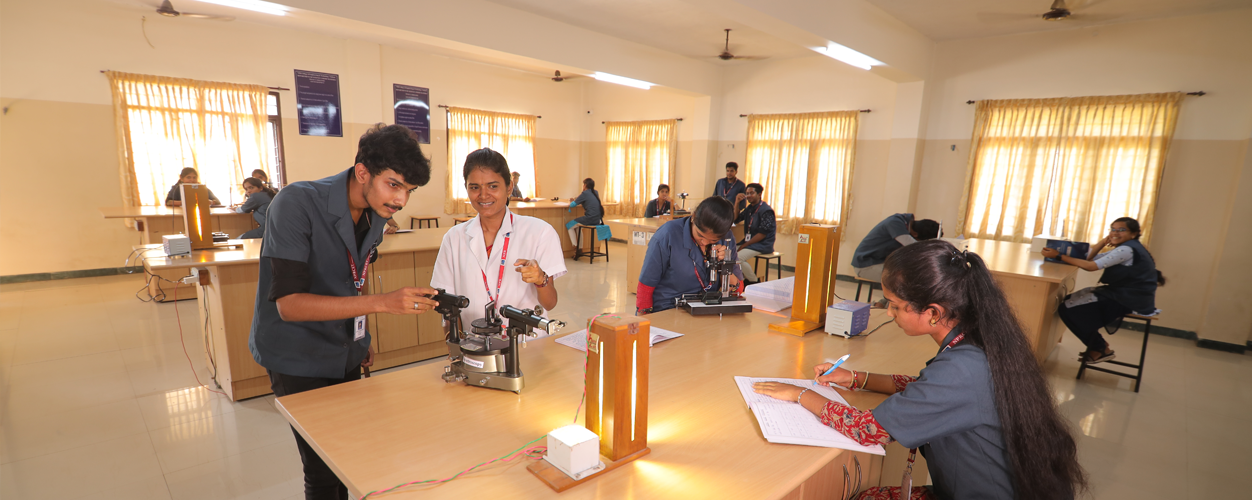
The Department of Science and Humanities is the gateway of engineering education. The spectacular Science and Humanities Department plays a significant role touching the souls of the students when they are fresh. Established in the year 2008, it strives to collate the approaches of Science and Technology by making the students ready to receive the hardcore engineering principles. It consists of Physics, Chemistry, Mathematics and English disciplines. All the disciplines in the department exist as a separate division and maintain individual identity under single umbrella. The unique strength of the department is its excellent co-ordination in carrying out the academic responsibilities effectively. The faculty members are highly qualified and dedicated. The department has spacious and well-equipped laboratories. The department aims to transfer the younger generation into responsible citizens and aspires to lead the budding engineers towards the path of success. It seeks to sustain and enhance excellence in an institution of higher learning of technology. It is committed to produce competent graduates with the suitable skills required for industry and market place adding to provide better communication skills, technical skills and soft skills to the young aspirants of the institution. The department is committed to provide innovative and high-quality instruction that empowers students to become confident in facing personal and professional life challenges.
Preparing students to attain excellence in education.
Computer Science and Engineering is one of the most dynamic and transformative disciplines in the modern technological era. The department is committed to delivering high-quality education that blends strong theoretical foundations with practical computing skills, enabling students to address real-world challenges through innovation, critical thinking, and ethical responsibility. With a future-focused curriculum and learner-centric pedagogy, the department prepares graduates to contribute meaningfully to the global digital economy.
The scope of CSE extends across diverse sectors including information technology, artificial intelligence, healthcare, finance, education, manufacturing, governance, and research. Rapid advancements in intelligent computing, data-driven technologies, automation, and cloud-based infrastructure have created unprecedented demand for skilled computer science professionals.
The programme equips students with expertise in programming, system design, analytics, cybersecurity, and emerging technologies required to thrive in competitive international environments.
Exposure to cutting-edge technological domains aligned with current industry trends.
High demand for CSE graduates in multinational corporations, startups, research laboratories, technology firms, and public sector technology organizations.
A wide range of opportunities are available through competitive examinations, technical recruitments, Central and State Government departments, and Public Sector Undertakings (PSUs).
The department fosters a vibrant ecosystem of research, innovation, and industry engagement through funded projects, advanced laboratories, publications, patents, hackathons, internships, and collaborative development initiatives.
Partnerships with technology companies and research organizations provide experiential learning, certification opportunities, and real-time project exposure, strengthening students’ professional readiness.
Beyond technical competence, the department emphasizes ethical computing, sustainability, inclusivity, and social responsibility.
Students are motivated to design technology-driven solutions that address societal challenges in healthcare, education, environment, and smart infrastructure, thereby contributing to national development and global progress.
Graduates of Computer Science and Engineering Program will be able to:
Develop into the most knowledgeable professional to pursue higher education and Research or have a successful carrier in industries.
Successfully carry forward domain knowledge in computing and allied areas to solve complex and real world engineering problems.
Meet the technological revolution they are continuously upgraded with the technical knowledge.
Serve humanity with social responsibility and ethical values.
Apply knowledge of mathematics, natural science, computing, engineering fundamentals and an engineering specialization to develop to the solution of complex engineering problems.
Identify, formulate, review research literature and analyze complex engineering problems reaching substantiated conclusions with consideration for sustainable development.
Design creative solutions for complex engineering problems and design/develop systems /components /processes to meet identified needs with consideration for the public health and safety, whole-life cost, net zero carbon, culture, society and environment as required.
Conduct investigations of complex engineering problems using research-based knowledge including design of experiments, modelling, analysis & interpretation of data to provide valid conclusions.
Create, select and apply appropriate techniques, resources and modern engineering & IT tools, including prediction and modelling recognizing their limitations to solve complex engineering problems.
Analyze and evaluate societal and environmental aspects while solving complex engineering problems for its impact on sustainability with reference to economy, health, safety, legal framework, culture and environment.
Apply ethical principles and commit to professional ethics, human values, diversity and inclusion; adhere to national & international laws.
Function effectively as an individual, and as a member or leader in diverse/multi-disciplinary teams.
Communicate effectively and inclusively within the engineering community and society at large, such as being able to comprehend and write effective reports and design documentation, make effective presentations considering cultural, language, and learning differences.
Apply knowledge and understanding of engineering management principles and economic decision-making and apply these to one’s own work, as a member and leader in a team, and to manage projects and in multidisciplinary environments.
Recognize the need for, and have the preparation and ability for i) independent and life-long learning ii) adaptability to new and emerging technologies and iii) critical thinking in the broadest context of technological change.
At the end of the program students will be able to,
Deal with real time problems by understanding the evolutionary changes in computing, applying standard practices and strategies in software project development using open-ended programming environments.
Employ modern computer languages, environments and platforms in creating innovative career paths by inculcating moral values and ethics.
Achieve additional expertise through add-on and certificate programs.
| S.No. | Batch | Course Outcomes |
|---|---|---|
| 1 | Course outcome- R 2021 - CSE | View Course Outcome |
| S.No | Name of the Members | Designation | Organization | Position in DAC |
|---|---|---|---|---|
| 1 | Mrs. Sujitha V | Head of the Department, Department of Computer Science and Engineering | NPR College of Engineering and Technology, Natham, Dindigul | Chair Person & HOD |
| 2 | Dr.S.Selvaperumal | Principal | NPR College of Engineering and Technology, Natham, Dindigul | IQAC Chairman |
| 3 | Mrs.R.Joan Pavithra | Assistant Professor, Department of Computer Science and Engineering | NPR College of Engineering and Technology, Natham, Dindigul | Department IQAC Coordinator |
| 4 | Mr.R.K.Duresh | Senior Project Engineer | Wipro Technologies | R&D Member |
| 5 | Mr.R.Saravana Kumar | Project Manager | Iconix Software Solutions, Tirunelveli | Industry Member |
| 6 | Ms.B.Kamali | Tata Consultancy Services Chennai. (Batch: 2018-2022) |
Tata Consultancy Services | Alumni Member |
| 7 | Mr.S.Yogesh Kanna | Triemp Technology Services Chennai. (Batch: 2017-2021) |
Triemp Technology Services | Alumni Member |
| 8 | Ms.R.Akshal | Final Year CSE Student | NPR College of Engineering and Technology, Natham, Dindigul | Student Member |
| 9 | Mrs.A.Chitra | Record Clerk, East Taluk, Dindigul | East Taluk, Dindigul | Parent |
| 10 | Mrs.R.Vahitha Rehman | Rural Development Officer | Collector Office, Dindigul | Parent |
| 11 | Dr.M.IndiraDevi | Professor, Department of Computer Science and Engineering | NPR College of Engineering and Technology, Natham, Dindigul | Internal Member |
| 12 | Mr.M.Arockia Irudayaraja | Assistant Professor, Department of Computer Science and Engineering | NPR College of Engineering and Technology, Natham, Dindigul | Internal Member |
The members of the Board of studies are as follows:
| S/N. | Member Category | Name, Designation, and Affiliation |
|---|---|---|
| 1 | Chairman |
Mrs. V. Sujitha Assistant Professor, Department of Computer Science and Engineering, NPR College of College of Engineering and Technology, Dindigul-624401. |
| 2 | University Nominee |
Dr. V. Ramya Professor, Department of Computer Science and Engineering, Government College of Engineering, Bodinayakanur. |
| 3 | Subject Experts from outside the Parent University |
Dr. S. Sreethar Associate Professor, School of Computer Science and Engineering, Vellore Institute of Technology, Vellore-632014. Dr. K. Saravanan Professor, Department of Artificial Intelligence and Data Science, Kathir College of Engineering, Coimbatore. |
| 4 | Experts from outside the Autonomous College |
Dr. V. Murali Bhaskaran Professor in CSE and Dean Academics, Rajalakshmi Engineering College, Rajalakshmi Nagar, Thandalam, Chennai - 602105. |
| 5 | Expert from Industrial/ Corporate/Allied Sector |
Mr. R. K. Durgesh Senior Associate & Technical Lead, Cognizant Technology Solutions India Pvt. Ltd. ELCOT SEZ, Sholinganallur, Chennai- 600119. |
| 6 | College Alumni |
Mr. K. B. Seshan Senior Developer, Corestack, RMZ One Paramount, Plot:110 1st Floor, Mount Poonamallee Road, Porur, Chennai-600024. Computer Science and Engineering |
| 7 | All Faculty Members | Dr. S.M.Vijayarajan, ASP |
| 8 | Mr.P.Manivel Pandian,AP | |
| 9 | Mr. M. Arockia Irudayaraja,AP | |
| 10 | Mrs. M.Kalarani,AP | |
| 11 | Mrs. R. Joan Pavithra,AP | |
| 12 | Mrs. J. Bama,AP | |
| 13 | Mrs. A. Arul Princy,AP | |
| 14 | Mr. N. Nagaprakash,AP | |
| 15 | Mrs. P. Prema,AP | |
| 16 | Ms. A. Yuvarani,AP | |
| 17 | Ms. M. Janani,AP | |
| 18 | Mr.A.Janagan,AP | |
| 19 | Mr.A.Suresh ,AP | |
| 20 | Mrs.S.Sharmila Jeyarani ,AP | |
| 21 | Mrs. P. Kaleeswari,AP | |
| 22 | Mrs. S. Indhumathi,AP |
| S.No. | Name of the Faculty | Designation |
|---|---|---|
| 1 | Dr. A. Kanimozhi | First Year Coordinator & Associate Professor / Mathematics |
| 2 | Dr. M. Sridharan | Professor / Mathematics |
| 3 | Dr. J. Pandimadevi | Assistant Professor / Mathematics |
| 4 | Dr. M. Ramakrishnan | Assistant Professor / Mathematics |
| 5 | Dr. K. Kavitha | Assistant Professor / Mathematics |
| 6 | Dr. P. Poomalai | Assistant Professor / Mathematics |
| 7 | Dr. V. Hemalatha | Assistant Professor / Mathematics |
| 8 | Mrs. D. Lakshmi | Assistant Professor / Mathematics |
| 9 | Mrs. C. Yogitha | Assistant Professor / Mathematics |
| 10 | Dr. B. Prakash | First Year Coordinator (i/c) & Associate Professor / Physics |
| 11 | Dr. N. Kavitha | Associate Professor / Physics |
| 12 | Dr. J. Ashok Kumar | Assistant Professor / Physics |
| 13 | Dr. T. Srinivasan | Assistant Professor / Physics |
| 14 | Dr. K. Selvakumar | Assistant Professor / Physics |
| 15 | Mrs. S. Aafrin Hazaana | Assistant Professor / Physics |
| 16 | Dr. S. Ananthakrishnan | Professor / Chemistry |
| 17 | Dr. A. Rajesh Kanna | Assistant Professor / Chemistry |
| 18 | Dr. K. Dhahagani | Assistant Professor / Chemistry |
| 19 | Dr. M. Velammal | Assistant Professor / Chemistry |
| 20 | Dr. D. Umapathi | Assistant Professor / Chemistry |
| 21 | Dr. S. Rajkumar | Assistant Professor / Chemistry |
| 22 | Dr. G. Balamurugan | Assistant Professor / Chemistry |
| 23 | Dr. S. Ramesh | Assistant Professor / English |
| 24 | Dr. V. Vijayalakshmi | Assistant Professor / English |
| 25 | Dr. R. Isvariya | Assistant Professor / English |
| 26 | Ms. M. Nagalakshmi | Assistant Professor / English |
| 27 | Mrs. A. Maha Sundari | Assistant Professor / English |
| 28 | Dr. Beaulah Wiseline | Assistant Professor / English |
| 29 | Dr. M. Sankaralagu | Associate Professor / Tamil |
| 30 | Dr. P. Jeyasankar | Assistant Professor / Tamil |
| S.No | Name | Designation | Date of Joining | Experience |
|---|---|---|---|---|
| 1 | Mr. M. Kalidass | Lab Assistant | 04.10.2021 | 4 Years 9 Months 14 Days |
| 2 | Mr. R. Gopi | Lab Assistant | 03.12.2024 | 1 Year 7 Months 15 Days |
| 3 | Mr. R. Vijay | Lab Assistant | 20.05.2023 | 3 Years 4 Months 29 Days |
| S.No. | Name of the Society | Name of the Event | Resource Person | Name of the Industry | Academic Year |
|---|---|---|---|---|---|
| 1 | Association for Computing Machinery (ACM) | Inaugural Ceremony of the NPRCET ACM Student Chapter |
Dr.Meenakshi D’Souza President, ACM India Council; Professor & Head, Department of Computer Science and Engineering |
IIIT Bangalore | 2024-2025 |
| 2 | Association for Computing Machinery (ACM) | Peer Learning Session on “Bridging Minds: Sustaining Knowledge Exchange” |
Dr. P. Nagaraj, Associate Professor & Seceretary Madurai ACM Professional Chapter. |
Kalasalingam Academy of Research and Education | 2024-2025 |
| S/N. | Year | Company | Period of MoU |
Duration (In Years) |
Objective | Outcome | Status |
|---|---|---|---|---|---|---|---|
| 1 | 2021-2022 | C3 Technologies, Coimbatore | 08.03.2021 - 07.03.2026 | 5 years | To collaborate with industry for providing internships, in-plant training, faculty development programs, placements, and industrial exposure to students and faculty. |
|
Active |
| 2 | 2022-2023 | ICONIX Software Solution, Tirunelveli | 06.09.2022 - 05.09.2027 | 5 years | To strengthen industry–academia interaction by offering internships, faculty training, workshops, placements, and industrial visits. |
|
Active |
| 3 | 2023-2024 | VEI Technologies, Chennai | 18.12.2023 - Lifetime | Lifetime | To establish a long-term collaboration for skill development through internships, training programs, FDPs, and VAC |
|
Active |
| 4 | 2024-2025 | AskEva Communications Private Limited, Madurai | 09.09.2024 - 08.09.2027 | 3 Years | To promote practical learning and employability by offering internships, training programs, and industry interaction. |
|
Active |
| 5 | 2024-2025 | Inspire Softech Solutions, Chennai | 20.11.2024 - 19.11.2027 | 3 Years | To promote practical learning and employability by offering internships, training programs, and industry interaction. |
|
Active |
| 6 | 2024-2025 | Accent Techno Soft, Coimbatore | 24.02.2025 - 23.02.2028 | 3 Years | To enhance student competencies and faculty expertise through internships, FDPs, value-added courses, and industry visits. |
|
Active |
| 7 | 2025-2026 | Altitudes,Coimbatore | 23.10.2025-22.10.2025 | 3 Years | To foster academic–industry collaboration for knowledge sharing, skill development, and professional growth. |
|
Active |
| S/N. | Academic Year | Date | Name of the Activity | Participants |
|---|---|---|---|---|
| 1 | 2023 - 2024 | 22.09.2023 | One day Workshop on Cloud Practitioner in AWS | III Year |
| 2 | 2023 - 2024 | 18.12.2023 & 19.12.2023 | Two Days Workshop on Python Applications | II Year & III Year |
| 3 | 2023 - 2024 | 15.04.2024 | Guest Lecture on “Mobile App Development” | III & IV Year |
| 4 | 2024-2025 | 09.09.2023 | Workshop on Digital Marketing | III and IV Year |
| 5 | 2024-2025 | 20.11.2024 | Workshop on Data Science using Python | II Year & III Year |
| 6 | 2024-2025 | 14.10.2024 to 18.10.2025 | Value Added Course on “Git and Git- Hub” | II Year |
| 7 | 2024-2025 | 21.01.2025 to 23.01.2025. | Value-Added Course on "Power BI" | III Year |
| 8 | 2024-2025 | 24.02.2025 | Workshop on "Innovation in Flutter for Web & Desktop: Expanding Beyond Mobile" | II Year & III Year |
| 9 | 2025-2026 | 23.10.2025 | Guest Lecture on Next-Generation Innovations in Software Testing and Automation | III Year |
| 10 | 2025-2026 | 3.11.2025 to 07.11.2025 | Value Added Course on “Git and Git- Hub” | II Year |
Fill the form below — our counsellor will get in touch shortly.